Material Guide
The Complete Guide to Wood Veneer Wallcovering
Everything architects, designers and distributors need to know about wood veneer wallcovering — from species selection and cut techniques to technical specifications, installation and sourcing.
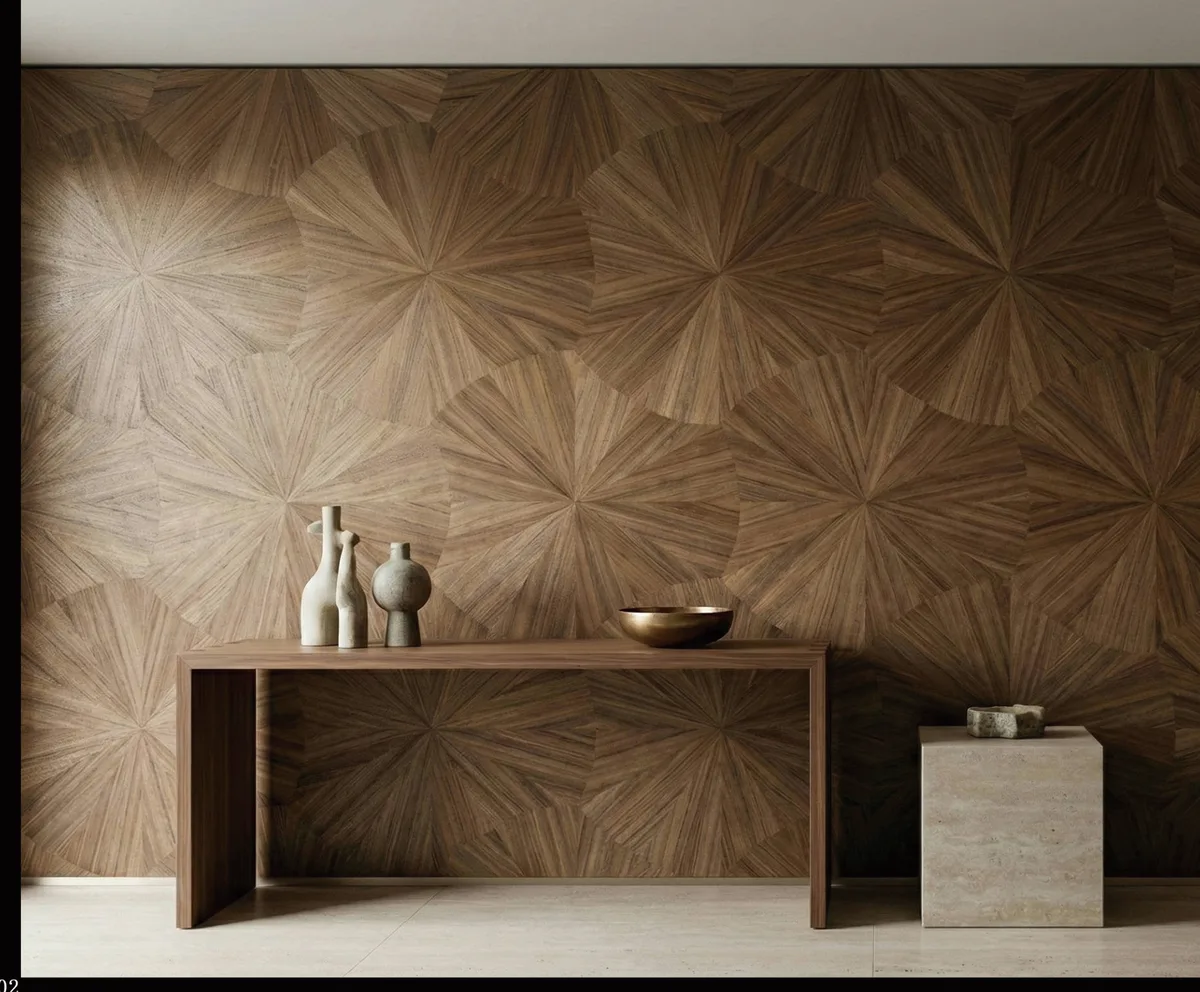
What Is Wood Veneer Wallcovering?
Wood veneer wallcovering is a natural wallcovering made from ultra-thin slices of real wood — typically 0.2 mm to 0.6 mm thick — laminated onto a flexible paper, non-woven or fabric backing. This allows genuine wood grain to be applied to walls with the same installation methods used for traditional wallcoverings.
Unlike faux wood wallpapers that print a photographic image of wood grain, veneer wallcoverings are real wood. Every sheet carries the authentic grain pattern, knots, mineral streaks and natural color variation of the original tree. This authenticity is instantly visible and tactile — you can feel the wood grain under your fingertips.
Wood veneer wallcoverings solve a fundamental design problem: they deliver the warmth and prestige of solid wood paneling at a fraction of the weight, cost and installation complexity. A feature wall that would require a carpenter and days of solid wood installation can be achieved in hours with flexible veneer on a roll.
Key Fact: Wood veneer wallcovering weighs approximately 300–500 g/m² — roughly 1/100th the weight of equivalent solid wood paneling. This makes it suitable for walls that cannot support heavy cladding, including drywall partitions, curved surfaces and even ceilings.
Popular Wood Species for Wallcovering
The species of wood determines the veneer's color, grain pattern and overall character. The most commonly specified species for wallcovering applications include:
| Species | Grain Character | Color Range | Best For |
|---|---|---|---|
| Walnut | Rich swirling grain, cathedral patterns | Deep chocolate to warm brown | Executive offices, luxury residential, hotel suites |
| Oak | Strong, linear grain with ray flecks | Golden honey to pale straw | Corporate lobbies, Scandinavian-style interiors |
| Teak | Straight, tight grain with oil sheen | Golden brown to amber | Yacht interiors, tropical hospitality, spa |
| Ebony | Dense, fine grain with striping | Jet black to dark brown streaks | High-contrast feature walls, luxury retail |
| Maple | Fine, uniform grain with bird's eye figures | Creamy white to pale gold | Minimalist modern, healthcare, clean aesthetics |
| Ash | Bold, pronounced grain lines | Light tan to medium brown | Contemporary residential, boutique retail |
| Reconstituted | Engineered grain — uniform and repeatable | Any color (dyed) | Large-scale commercial, consistency-critical projects |
Designer Tip: Reconstituted veneer (also called "engineered veneer" or "recon") is made by slicing, dyeing and reassembling fast-growing plantation wood into consistent sheets that mimic exotic species. It offers the look of rare woods like ebony or rosewood without the sourcing restrictions, making it an increasingly popular choice for sustainability-conscious projects.
Veneer Cut Techniques
How a log is sliced dramatically affects the resulting grain pattern. Understanding cut techniques helps designers specify the exact visual effect they want:
1. Flat Cut (Plain Sliced)
The log is cut tangentially through the center, producing the classic "cathedral" or "flame" pattern most people associate with wood grain. This is the most common and economical cut, offering maximum visual drama.
2. Quarter Cut
The log is quartered and then sliced perpendicular to the growth rings, producing straight, parallel grain lines. Quarter-cut veneer is more stable dimensionally and creates a refined, linear aesthetic. In oak, this cut reveals distinctive "ray fleck" patterns.
3. Rift Cut
Similar to quarter cut but at a slight angle to the growth rings. Rift cutting produces the straightest possible grain with minimal figure — ideal for contemporary, minimalist applications where a calm, uniform wood surface is desired.
4. Rotary Cut
The log is mounted on a lathe and peeled in a continuous sheet, like unrolling a paper towel. Rotary cutting maximizes yield and produces broad, dramatic grain patterns. It's the most cost-effective method but produces the least consistent grain.
Technical Specifications
The following specifications are typical for commercial-grade wood veneer wallcoverings. Exact values vary by species, cut and backing type.
| Property | Specification |
|---|---|
| Face Material | Natural wood veneer, 0.2–0.6 mm thick |
| Backing | Non-woven fleece or paper backing (some with fabric interlayer) |
| Total Thickness | 0.5–1.0 mm (including backing) |
| Width | 0.60–1.22 m (24–48 in), species-dependent |
| Roll Length | 2.5–3.0 m (8–10 ft) per sheet, or continuous rolls up to 10 m |
| Weight | 300–500 g/m² |
| Fire Rating | ASTM E84 Class A / Class B (with fire-retardant treatment) |
| Finish | Raw (unfinished), lacquered, oiled, or UV-coated |
| Flexibility | Can flex to curved surfaces with radius ≥ 300 mm (species-dependent) |
| Adhesive | PVA or contact adhesive; paste-the-wall method |
| Edge Treatment | Bookmatched, slip-matched or random-matched panels |
| Maintenance | Wipe with dry or lightly damp cloth; re-oil/re-lacquer periodically |
For Specifiers: Wood veneer wallcovering falls under CSI MasterFormat Section 09 72 00 — Wall Coverings or 06 42 00 — Wood Paneling depending on the project scope. For commercial installations requiring ASTM E84 Class A, specify fire-retardant treated veneer and confirm compliance with the manufacturer's test report. Always request a sample panel for architect approval before production.
Matching Patterns
How adjacent veneer sheets are arranged on the wall dramatically affects the visual result. The three standard matching methods are:
Bookmatch
Every other sheet is flipped, like opening a book. The grain pattern mirrors across the seam, creating a symmetrical, butterfly-wing effect. Bookmatch is the most popular method for feature walls and delivers maximum visual impact.
Slip Match
All sheets are applied in the same direction, with grain patterns repeating side by side. Slip match creates a consistent, uniform flow — ideal for long corridors or large areas where a calm, continuous wood surface is desired.
Random Match
Sheets are applied without regard to grain alignment, producing a more organic, varied appearance. Random match works well in rustic or contemporary settings where controlled imperfection is part of the design intent.
Best Applications
Wood veneer wallcovering's combination of authentic aesthetics and practical flexibility makes it suitable for a wide range of interiors:
- Hotels & Hospitality: Guest room headboard walls, lobby feature panels, elevator cab interiors, restaurant accent walls. Wood veneer delivers the luxury of timber paneling without the structural requirements.
- Corporate & Office: Executive offices, boardrooms, reception desks (wrapped veneer), conference room walls. The warmth of real wood creates a refined, premium environment that paint and vinyl cannot replicate.
- Luxury Residential: Living room feature walls, study/library paneling, walk-in closet interiors, bedroom accent walls. Wood veneer transforms a room at a fraction of the cost of solid wood.
- Retail & Showrooms: Window displays, product backdrops, changing rooms, brand experience zones. The authenticity of real wood elevates product presentation.
- Curved & Irregular Surfaces: Columns, archways, curved corridors, ceiling soffits. Flexible veneer can wrap surfaces that solid wood and rigid panels cannot.
Installation Considerations
Wood veneer wallcovering requires careful handling and professional installation. Key considerations:
- Wall Preparation: Surfaces must be smooth, flat, dry and primed. Any imperfections will show through the thin veneer face. For curved applications, use a flexible substrate or apply directly to the curved wall.
- Acclimation: Allow veneer sheets to acclimate in the installation room for 48–72 hours. Wood veneer is more sensitive to humidity changes than fiber-based wallcoverings.
- Adhesive Selection: Use the manufacturer-recommended adhesive. Contact adhesive provides the strongest bond for heavy sheets; PVA allows repositioning during installation.
- Seam Management: Pre-sequence and pre-match all sheets before applying adhesive. For bookmatched installations, verify the mirror pattern on the floor before committing to the wall.
- Trimming: Use a sharp utility knife with a steel straightedge. Veneer can chip if cut with a dull blade. Score the face side first.
- Finish Coat: If specified unfinished, apply lacquer, oil or UV coating after installation. This protects the wood face and enhances grain color.
- Light Protection: Real wood darkens or lightens with UV exposure over time (teak and cherry darken; walnut lightens). Specify UV-resistant finish for sun-exposed installations.
Maintenance & Care
Finished wood veneer wallcovering is relatively low-maintenance:
- Regular Cleaning: Wipe with a dry or lightly damp microfiber cloth. For lacquered finishes, a slightly damp cloth is safe; for oiled or raw finishes, use only a dry cloth.
- Scratch Repair: Minor surface scratches can often be buffed out or concealed with a matching wood wax stick or touch-up pen.
- Re-finishing: Oiled veneers can be refreshed with a maintenance coat of the same oil every 1–2 years. Lacquered finishes typically do not require re-coating for 5–10 years under normal interior conditions.
- Humidity Control: Maintain indoor humidity between 40–60% RH. Extreme dryness can cause veneer cracking; excessive moisture can cause warping or delamination.
- Impact Protection: While more resilient than painted drywall, wood veneer is a thin surface treatment — avoid sharp impacts. In high-traffic zones, consider chair rail or bumper guards.
Why Source Wood Veneer from China?
China is the world's largest processor and exporter of decorative wood veneer products. The country's manufacturing base combines access to both domestic and imported timber species with advanced slicing, dyeing and lamination technology.
Working directly with a specialized Chinese supplier like Grasscloths offers significant advantages:
- Species Diversity: Access walnut, oak, teak, ebony, maple, ash and dozens of reconstituted options through a single supplier — far broader selection than most Western distributors offer.
- Custom Cut & Match: Specify your preferred cut technique (flat, quarter, rift) and matching pattern (book, slip, random) for any species. Manufacturers can produce sample panels for architect approval before full production.
- Cost Advantage: Direct sourcing from Chinese manufacturers typically saves 50–70% compared to branded wood veneer wallcovering from European or American labels — for identical raw materials and comparable quality.
- Fire Treatment: Request factory-applied fire-retardant treatment to meet ASTM E84 or EN 13501 fire classification requirements, eliminating the need for field-applied treatments.
- Multi-Material Orders: Bundle wood veneer with grasscloth, sisal, cork, gold foil and mica wallcoverings in a single shipment, reducing logistics costs and simplifying procurement.
Ready to Source Wood Veneer?
Get physical samples, pricing and technical specs for our wood veneer wallcovering collections. We reply within 24 hours.
Request Samples Email Us